The short version: when a UK small business asks ChatGPT to recommend an accountant, the same small set of names comes up, mostly accounting software and a few online-first businesses. Everyone else is invisible. And the sources ChatGPT leans on overlap with Google's top results by just 16%. If your AI strategy is really just your SEO strategy, you are optimising for the wrong engine.
- Google and ChatGPT barely agree. Across 68 UK accountancy keywords, their top sources overlapped just 16%, and by zero for the questions people ask when they want to switch provider.
- Software brands dominate. FreeAgent (52%), Xero (51%) and QuickBooks (40%) were each named in more answers than any actual accountancy firm. The top firm, Crunch, trailed at 32%.
- Most companies are invisible. Recommendations concentrated onto roughly a dozen names; the overwhelming majority of UK businesses appeared in none of the 500 answers.
- Being named isn't being cited. One small firm's content was cited as a source in 38 answers while the business was named in just one, a winnable, durable form of visibility bigger brands miss.
- Nobody owns the category. Visibility is question-by-question: Crunch appeared in 19 of 20 runs for one query and just 2 of 20 for another.
- ChatGPT cites authority, not marketing. Government and regulator sites (28%) and firms' own pages (23%) dominated citations. Reddit, usually one of AI's most-cited sources, was just 1% here.
- The clock is ticking. Semrush projects AI search will overtake traditional search traffic by 2028.
Most AI-visibility research so far has been broad, US-centric, and fixated on which big brands get mentioned. We wanted something more useful for a UK audience: a single category, studied in depth, measuring not just who gets named but who gets left out entirely, who gets cited as a source, and how differently ChatGPT behaves from Google. So we used Visibly, the AI visibility tool we're building to do exactly this, to study UK accountancy and small-business legal services in detail. This piece covers the accountancy findings; we've since run the same test on UK law firms, another regulated profession, and the two categories behave surprisingly differently.
And this is not a problem for "someday". Semrush projects that AI search will overtake traditional search traffic by 2028, and its own study found ChatGPT cites pages ranking outside Google's top 20 almost 90% of the time. The shift is already under way; the only question is whether your company is visible for it.
The real story: the businesses that appear nowhere
Start with the finding that matters most, because it's the one that should concern the business reading this. Across 500 answers about UK small-business accountancy and legal help, recommendations concentrated onto roughly a dozen names. Every other business, the overwhelming majority of the thousands of accountancy practices operating in the UK, appeared in none of them.
In traditional search, invisibility is survivable: you rank eleventh, you're on page two, you claw your way up. In AI search there is no page two. There is one answer, and either your name is in it or it isn't. For most UK businesses right now, it isn't, and they have no way of seeing that happening, because it leaves no trace in their analytics. Their Google rankings can be perfectly healthy while they are completely absent from the channel their next client is actually using to choose.
That is the quiet risk this study is really about. Not "who's winning", the far larger group of companies who don't yet know they've been left out of the conversation entirely.
Google's winners are not ChatGPT's winners
The companies winning on Google are mostly not the ones ChatGPT recommends, and this time we can put a firmer number on it than most AI-visibility research bothers to. We took the 17 buyer questions from the study and, for each, built a cluster of the real keywords UK businesses type into Google, pulled from a commercial keyword database and ranked by UK search volume. That's 68 keywords in total, covering roughly 75,000 searches a month. For every one we pulled Google's live UK results, then lined the ranking domains up against the sources ChatGPT cited when answering the same underlying question.
Across all of it, Google's top ten and ChatGPT's cited sources overlapped by 16%. Ranking first on Google buys you almost nothing in the AI answer, because the two channels have come apart at the level of which sources they trust.
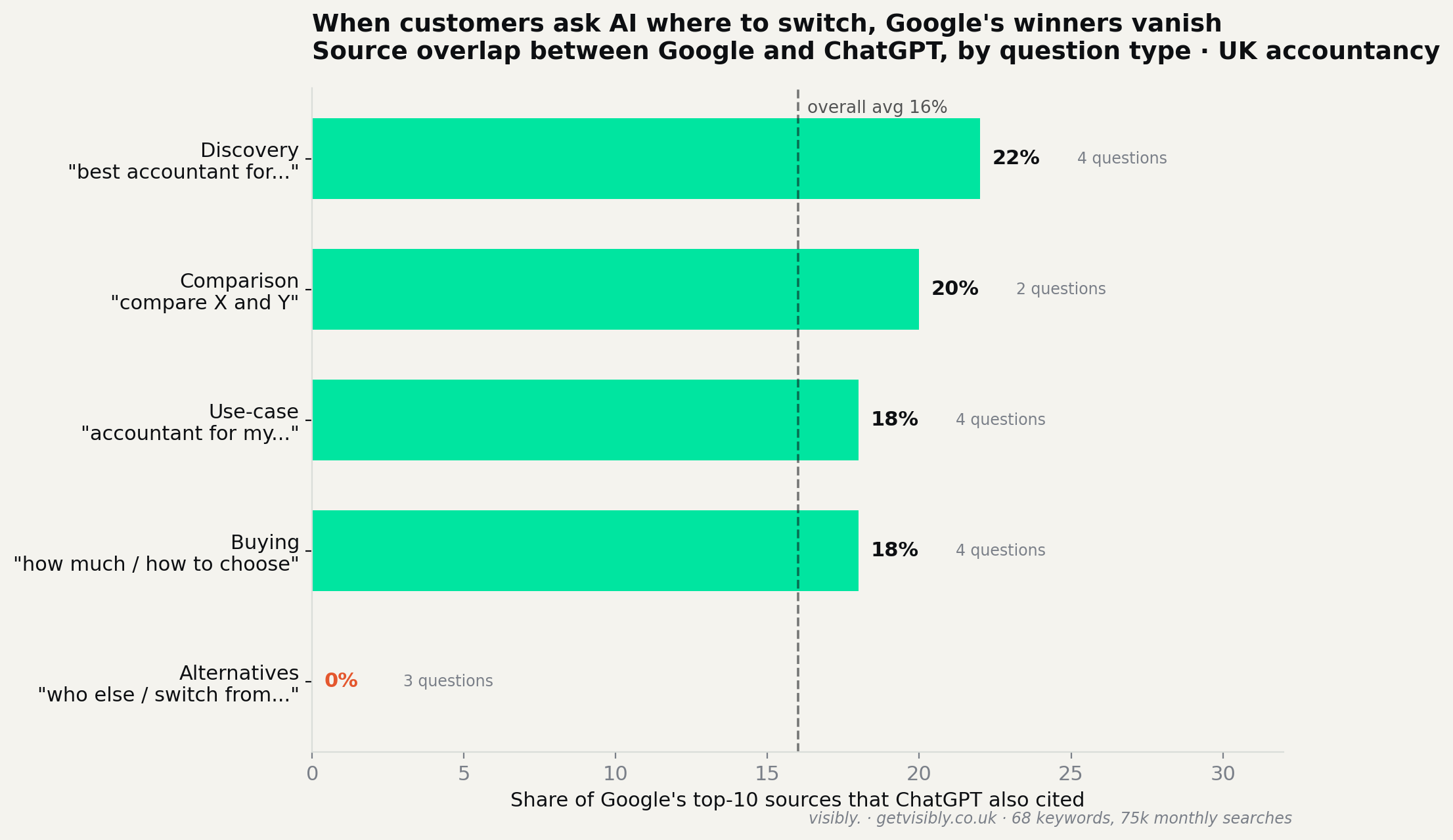
The average hides the more useful finding, which is that the gap depends entirely on what the customer is asking. Discovery questions, the "who are the best accountants for..." ones, overlapped 22%. Comparison and use-case questions sat around 18 to 20%. And one type of question stood completely apart. For "alternatives" questions, the ones a business asks when it's actively looking to switch away from its current accountant, Google and ChatGPT shared not a single source across three questions and twelve keywords. Zero overlap, on 12,000 searches a month.
That's the number to sit with if you do nothing else with this study. The moment a client is ready to leave their current provider and asks an AI what else is out there, the sources shaping that answer have no relationship to the ones you might have optimised for on Google. You could own page one for every "switch accountant" query in the country and be completely absent from the AI version of the same question.
Two AI answers, further apart than search itself
Here's the part we didn't expect. Google now puts its own AI Overview at the top of many of these results, above the blue links, and it cites its own sources. So we had three answers to compare for each question: Google's ranked pages, Google's AI Overview, and ChatGPT.
You'd assume the two AI systems would look broadly alike, both being AI answering the same query. They don't. Google's AI Overview overlapped ChatGPT's sources by 10%, which is lower than Google's ordinary search results managed. The two AI answers agree with each other less than the older technology agrees with either of them.
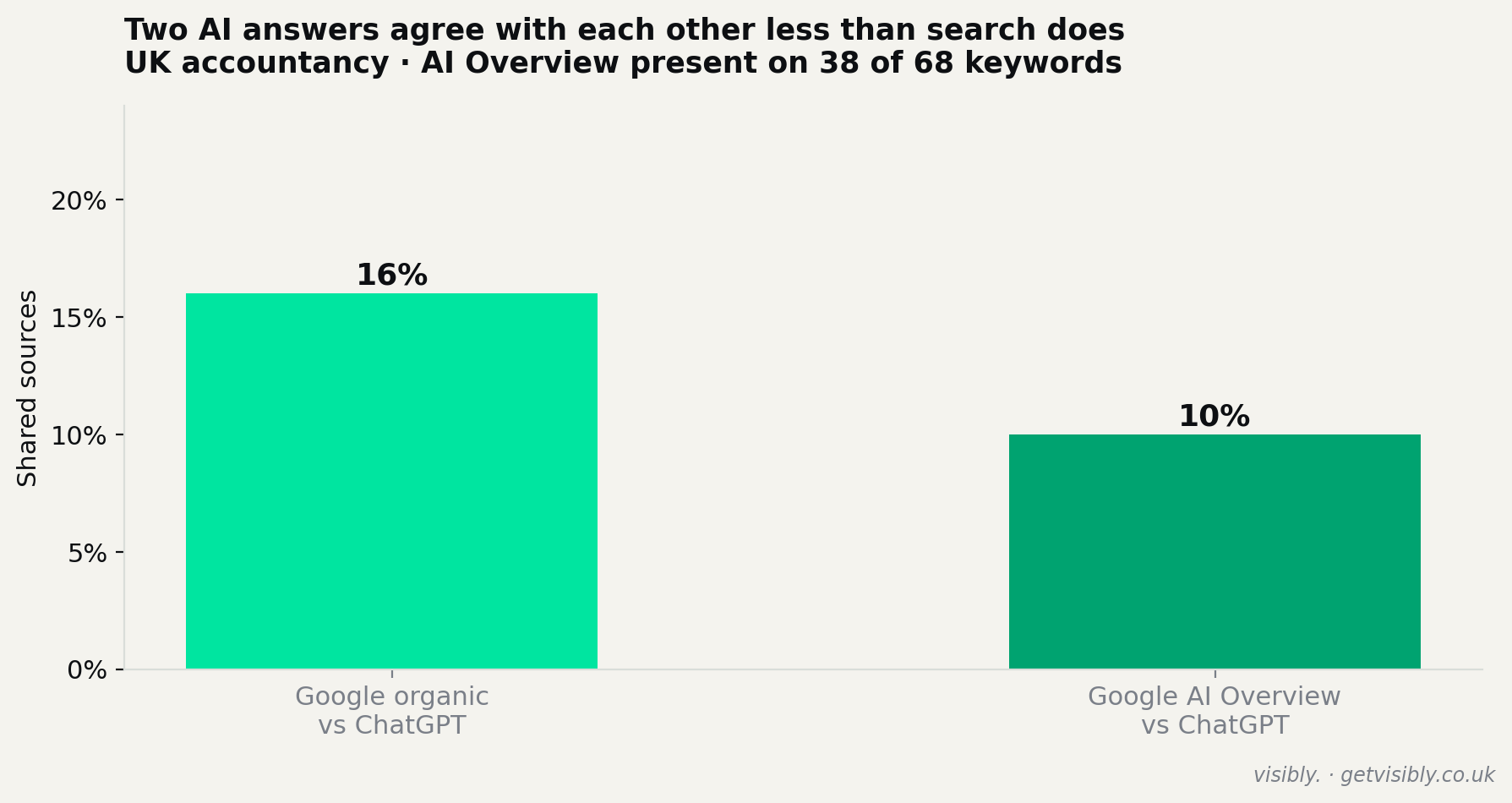
An AI Overview appeared on 38 of our 68 keywords, so this isn't a fringe case. It's the answer more than half of these searches now lead with. For a business, the practical consequence is blunt: there isn't one "AI visibility" to win. Being cited by ChatGPT and being cited in Google's AI Overview are close to separate problems, drawing on separate sets of sources, and showing up in one tells you very little about the other.
The one place the two converge is on factual questions. For "how much does an accountant cost", both lean on gov.uk, ICAEW and Unbiased, because there's a checkable answer and both reach for the same authorities. It's when the question turns to which company that they part company completely.
Software brands dominate the answer
When you ask ChatGPT about accountants, it largely answers by talking about accounting software. The three most-named brands across all 500 answers, FreeAgent (52%), Xero (51%) and QuickBooks (40%), are all software platforms. The most-mentioned actual accountancy firm, Crunch, comes fourth at 32%. That ranking is, in effect, this category's AI share of voice — accounting software owns the conversation ChatGPT has about accountants.
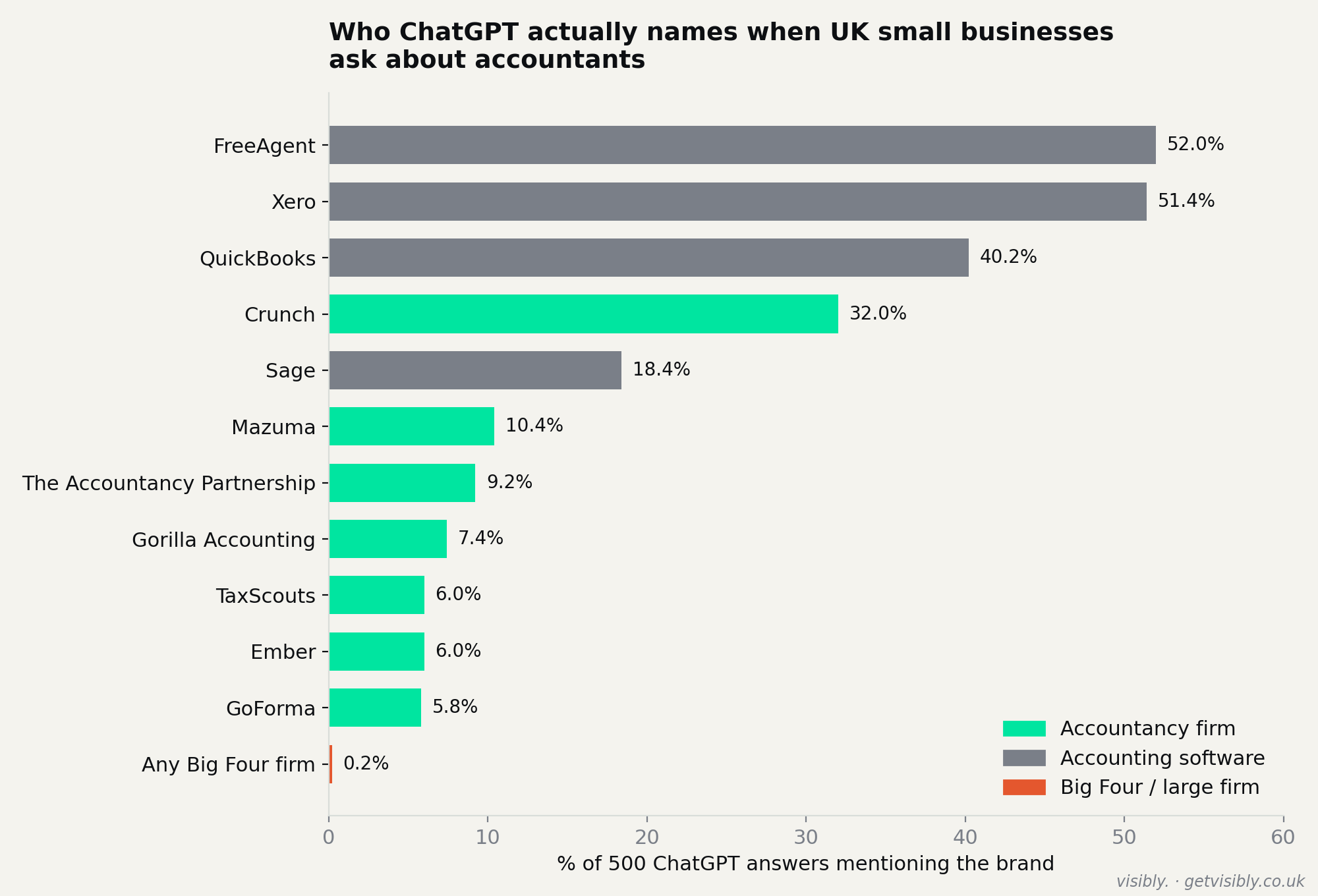
The reason is instructive. Years of content marketing from Xero, QuickBooks and FreeAgent, all of whom publish constantly on "how to choose an accountant" and "do I need an accountant", have made those brands the default vocabulary of the whole category. When ChatGPT reaches for an answer about accountancy, software is the language it already speaks. For a business, that means your most visible competitor in AI search may not be another company at all: it's the software your clients already use. (Large companies, incidentally, barely featured, unsurprising given every query was framed around small businesses, who aren't Deloitte's market.)
Mentioned vs cited, and which one you should actually want
A distinction most AI tools blur, and one that changes your strategy: a brand can be named in the answer without being cited as a source, and vice versa. These are two different kinds of visibility.
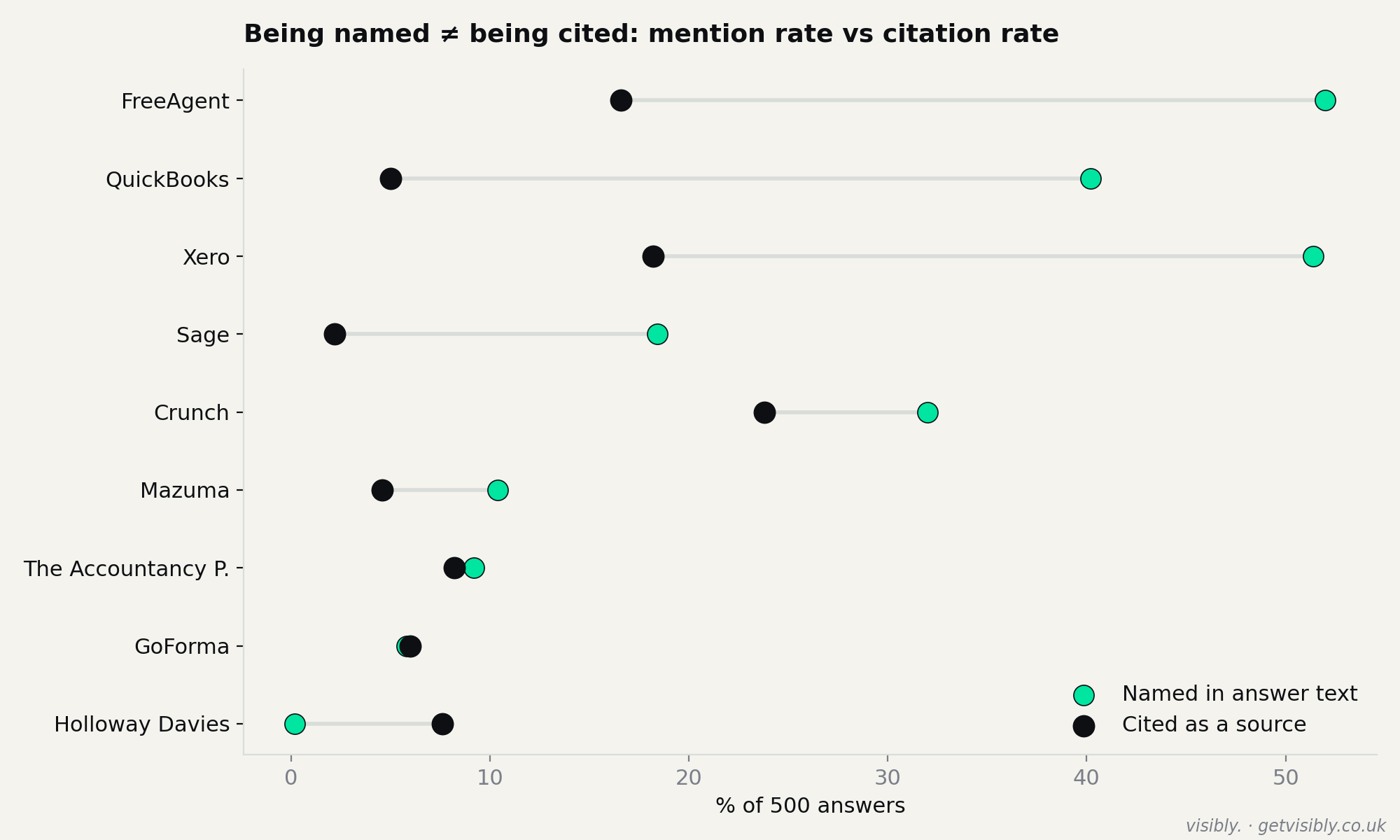
The extremes tell the story. QuickBooks is named in 40% of answers but cited as a source in only 5%, famous enough to be recalled from memory, but its content rarely does the grounding. Holloway Davies, a small company, is the mirror image: cited as a source in 38 answers while named in just one. Its content is quietly doing ChatGPT's homework across the category while the business gets almost no visible credit.
Our take: for a small company, being cited beats being mentioned
A mention pulled from the model's memory is fragile. You didn't earn it with anything specific, and you can lose it just as invisibly, when the model updates, or when a competitor publishes something more citable. It's brand equity you can't directly control.
A citation means your own content is actively grounding the answer right now. It's earned through pages you control, it's far more durable, and, crucially, it's winnable from a standing start, which a 52% mention rate is not. Holloway Davies didn't need Xero's brand; it needed to be the clearest answer to a specific question.
Does it depend on the query? Yes. For discovery questions, which, as we'll see, almost always trigger a live web search, citation is everything. For advisory questions answered from memory, mentions matter more. But for most companies most of the time, the achievable, durable goal is to be cited. That's the heart of getting cited by AI search.
Nobody owns the category, brands own individual questions
Because AI answers vary run to run, we ran every prompt 20 times, something a single-shot check can't do. It let us measure consistency, and consistency turns out to be the whole story. Only 32 brand-question combinations were "locked in" (named in 16+ of 20 runs); 58 flickered in and out (1 to 6 of 20).
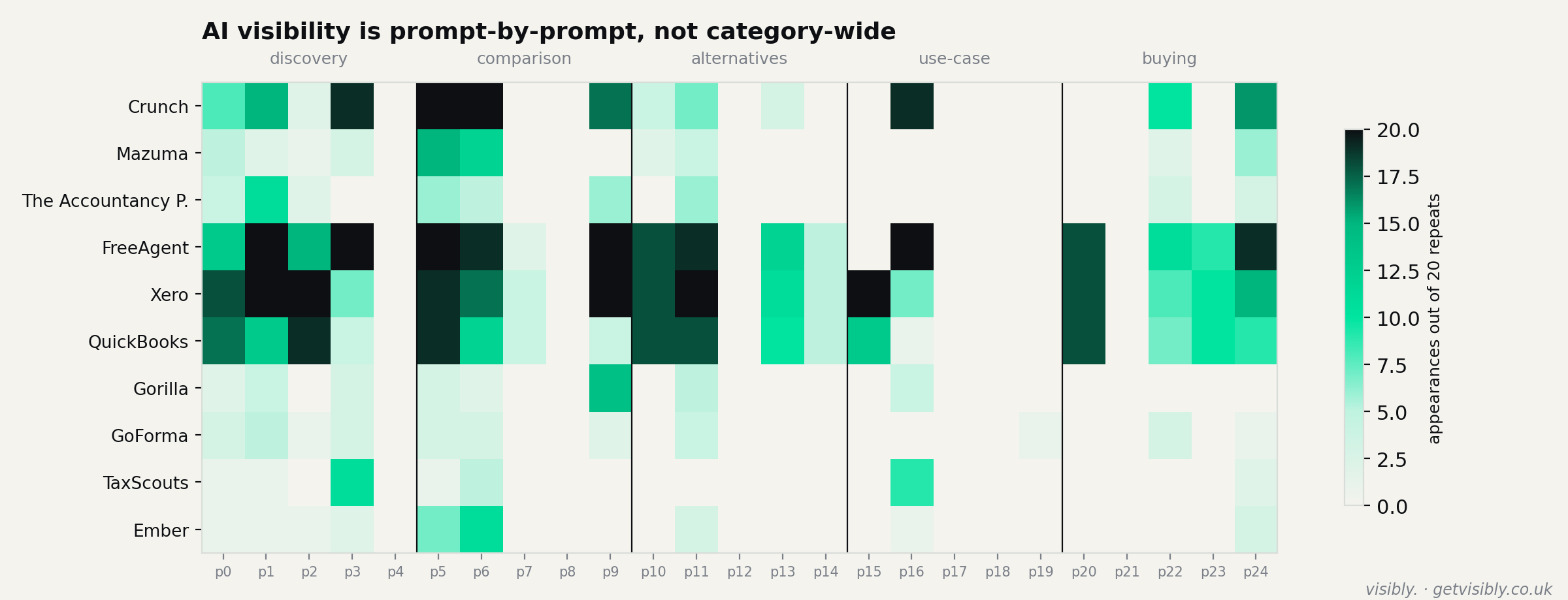
Crunch shows it clearly: named in 19 of 20 runs for the sole-trader question, but only 2 of 20 for the general "small business accountant" one. It doesn't own the category, it owns a query. That's the real unit of AI visibility: not "are we visible?" but "which exact questions are we reliably the answer to?" It's also why checking ChatGPT once tells you almost nothing, ask twice, get two different shortlists.
What ChatGPT actually cites
We classified all 2,255 cited sources. The mix is a useful corrective to the belief that AI visibility is won with blog content.
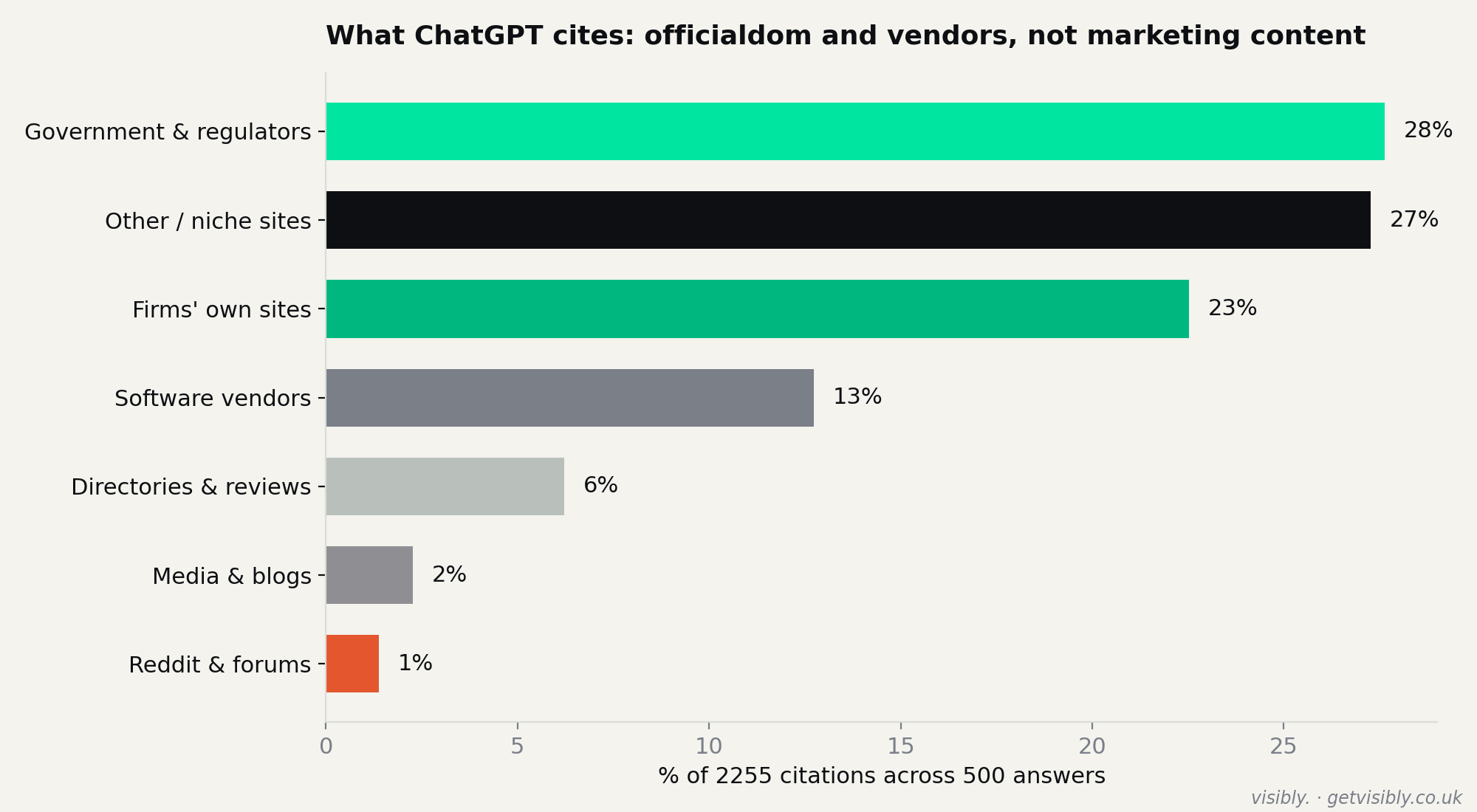
Government and regulator sites (gov.uk, ICAEW, the SRA, ACCA) were the largest category at 28%, then firms' own sites at 23%, then software vendors at 13%. Media and blogs together: 2%.
One divergence is worth dwelling on. Reddit made up just 1% of ChatGPT's citations here, and that's genuinely unusual. Across AI answers generally, Reddit is one of the most-cited domains on the entire web; ChatGPT leans on it heavily in most consumer categories, and it's prominent in Google's own SERPs for these exact accountancy queries. Its near-absence here tells you something specific about this category: for regulated professional services, ChatGPT reaches for institutional authority, regulators, formularies, established firms, over community opinion. Don't assume the Reddit-heavy pattern you've read about elsewhere applies to professional services. Here, it doesn't.
The "other" bucket (27%) is where the opportunity sits: a long tail of small, specific sites, niche comparison pages, individual firms' guides, cited because they answered a precise question well. You don't need to be big to be cited. You need to be the clearest available answer.
When ChatGPT bothers to search, and when it answers from memory
In a separate 125-call pass, we let the model decide for itself whether to search the web. How often it did depended sharply on the question type:
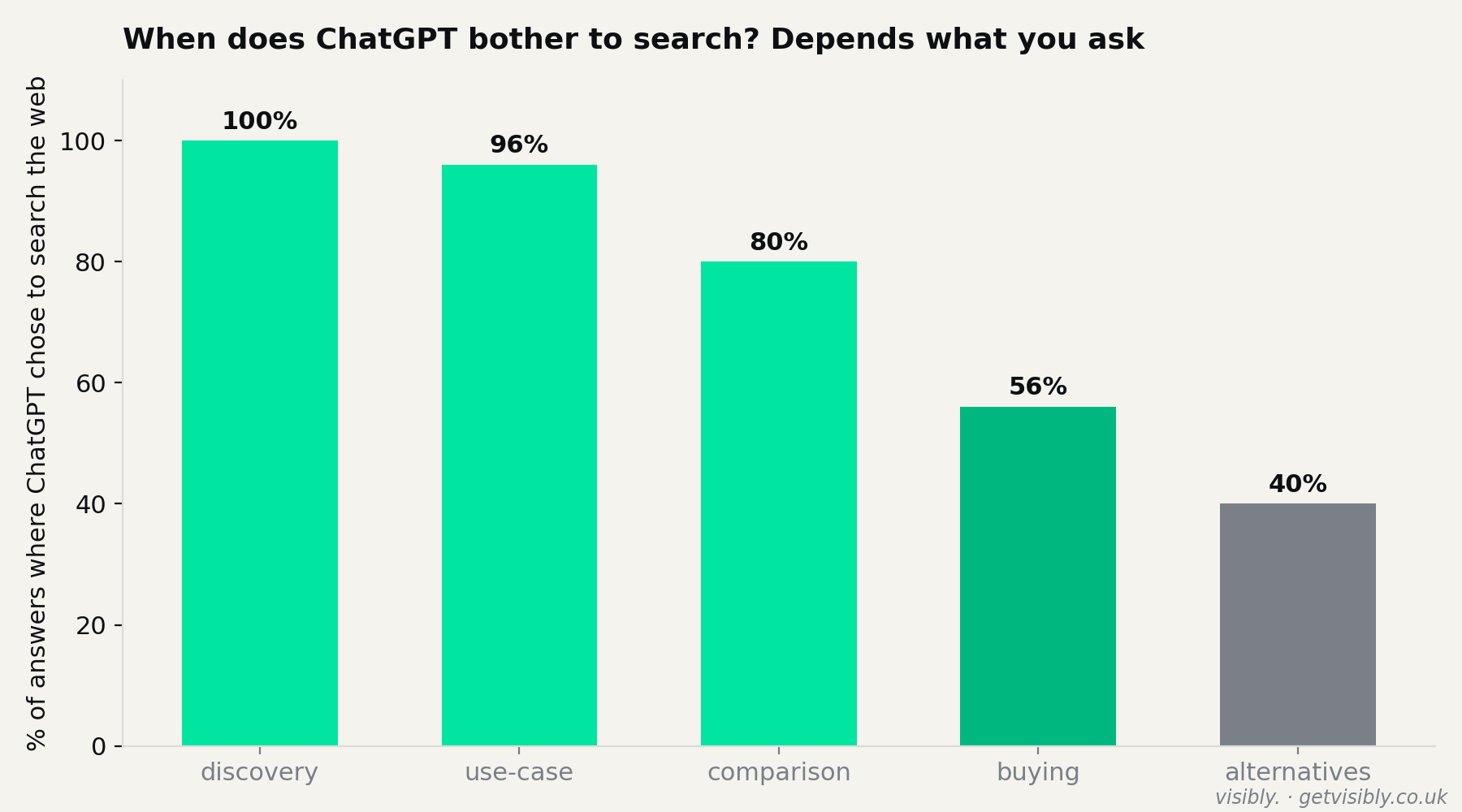
Discovery questions ("who are the best accountants for...") triggered a live search 100% of the time; "alternatives" questions just 40%. This is strategically important: for the questions ChatGPT searches, you can win with current, citable content in weeks. For the questions it answers from memory, visibility is a slower brand-building game. Knowing which is which tells you where your effort pays off fastest.
How we ran it with Visibly
Methodology
- 25 prompts, five each across five buyer intents (discovery, comparison, alternatives, use-case, buying). Every prompt is category-level, no company named in any prompt, so we measure who ChatGPT raises unprompted.
- Engine: OpenAI GPT-5.4 via the Responses API with live web search on, run through Visibly. Web search was forced on for all 500 primary calls (verified per call); a separate 125-call pass let the model choose, to measure search-trigger rates.
- 20 repeats per prompt (500 answers), enabling the consistency analysis, essential because AI answers are non-deterministic.
- 2,255 citations extracted and classified; brand mentions detected across a curated lexicon of UK companies, software and legal providers.
- Google comparison: for each buyer question we built a cluster of up to four real UK keywords, sourced from a commercial keyword database and ranked by search volume, giving 68 keywords across roughly 75,000 monthly searches. Live Google UK results and AI Overview citations were pulled through our API connection to DataForSEO in August 2026.
- Scope: one engine (ChatGPT), one point in time (10 to 11 August 2026). A multi-engine follow-up covering Gemini, Claude and Perplexity is in progress.
What this means for your business
1. Check whether you're in the answer at all. The biggest risk isn't ranking low, it's being absent, invisibly. Your Google analytics won't show it.
2. Don't assume SEO covers you. Google and ChatGPT overlap 16% here, and for switching-intent questions they overlap not at all. Separate channels, separate work.
3. Your AI competitor might be software. If Xero and QuickBooks own your category's vocabulary, your content has ground to reclaim.
4. Aim to be cited, not just mentioned. It's the durable, winnable game for a smaller company, and businesses in this very data have already shown it.
5. Win specific questions. Nobody owns the category. Find the exact questions your ideal client asks and become the reliable answer. This is generative engine optimisation.