When UK businesses ask AI to recommend a commercial law firm, the names that appear most often are CMS, Herbert Smith Freehills, Hogan Lovells, Stewarts and Quinn Emanuel. The companies that rank on Google for the same searches are almost entirely different. Across our tests on Visibly, only 6% of the companies on Google's page 1 were ones AI also recommended, which means the effort a law firm puts into ranking on Google is not enough to be visible to a prospect when they search for you on ChatGPT.
Here is how we found it, and if you're a business reading this, what your company can do about it with our help.
How we ran the study
We built Visibly to answer this question for any brand, so for this study we pointed our tool at UK commercial law. We took the eight areas of commercial law that UK businesses search for most in our data, which together draw more than 100,000 searches a month, and turned them into 25 prompt topics a real business owner would type into AI when they need a solicitor. Not "what is a breach of contract", but "a supplier has breached its contract with my company, which UK law firms are best for a breach of contract claim".
We ran every question 20 times with live web search on, recording which companies AI named and which websites it cited as a source, for 500 answers in total across the 25 topics. All prompts were non-branded, so every firm that came up is one AI chose without us giving it any branded information. We then pulled Google's own page-one results for the same searches, analysing the comparisons (or lack of). We know this is one AI engine at one point in time, where answers vary between runs, so we repeated each question 20 times with no personalised or logged-in responses, to get as accurate a picture as possible. For clarity, a mention is AI naming a firm in its answer. A citation is the website it links to as its source. They often come from completely different places, which is where the practical lessons start.
Finding 1: ranking on Google doesn't translate to being recommended by AI
We took the firms Google ranks on page one for each search, set them against the firms AI recommends for the same need, and measured how much the two lists share.
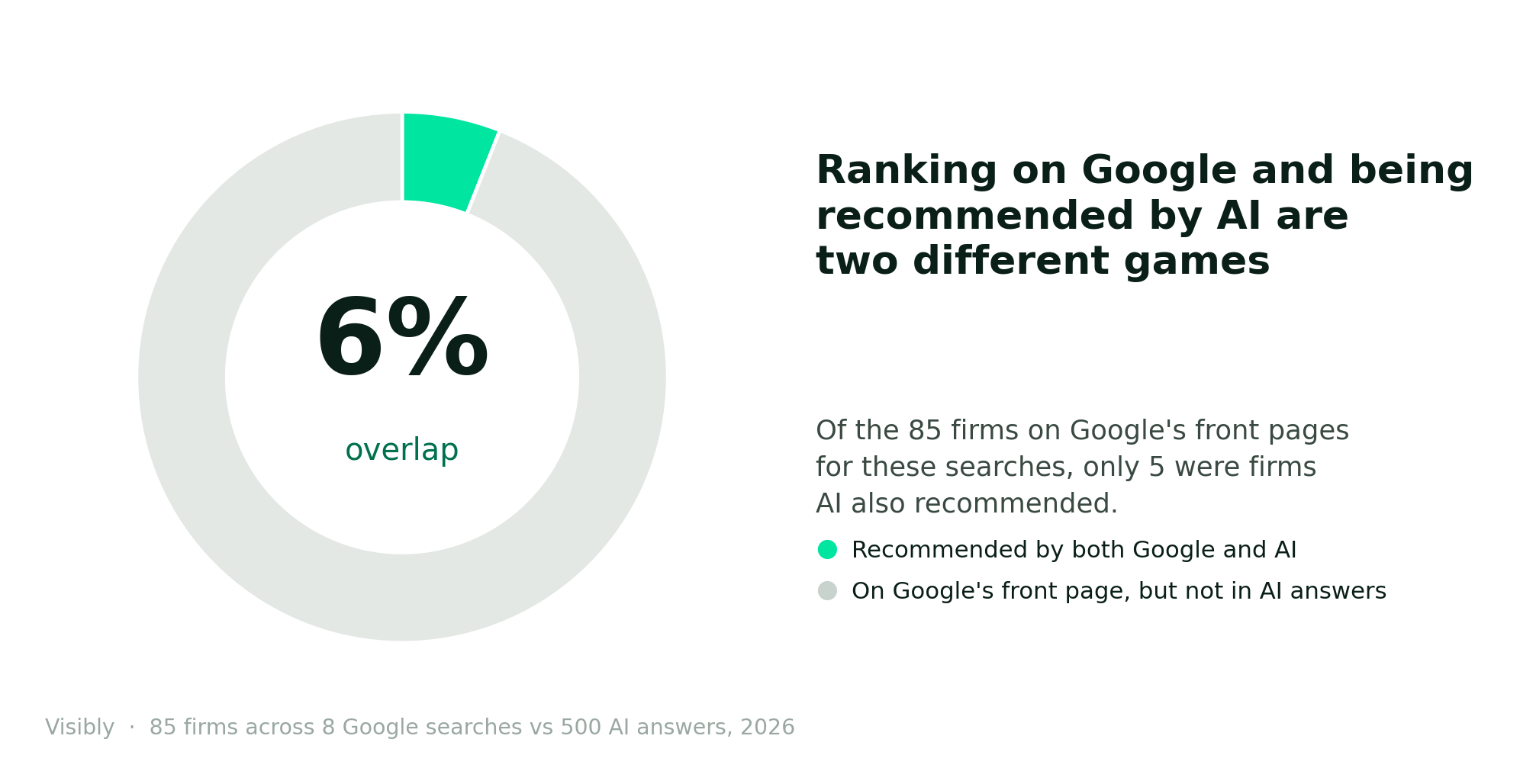
Of the 85 firms on Google's front pages for these searches, only five were names AI put forward, a 6 percent overlap which is considerably smaller than expected. Google and ChatGPT point towards almost entirely different companies, for similar topics.
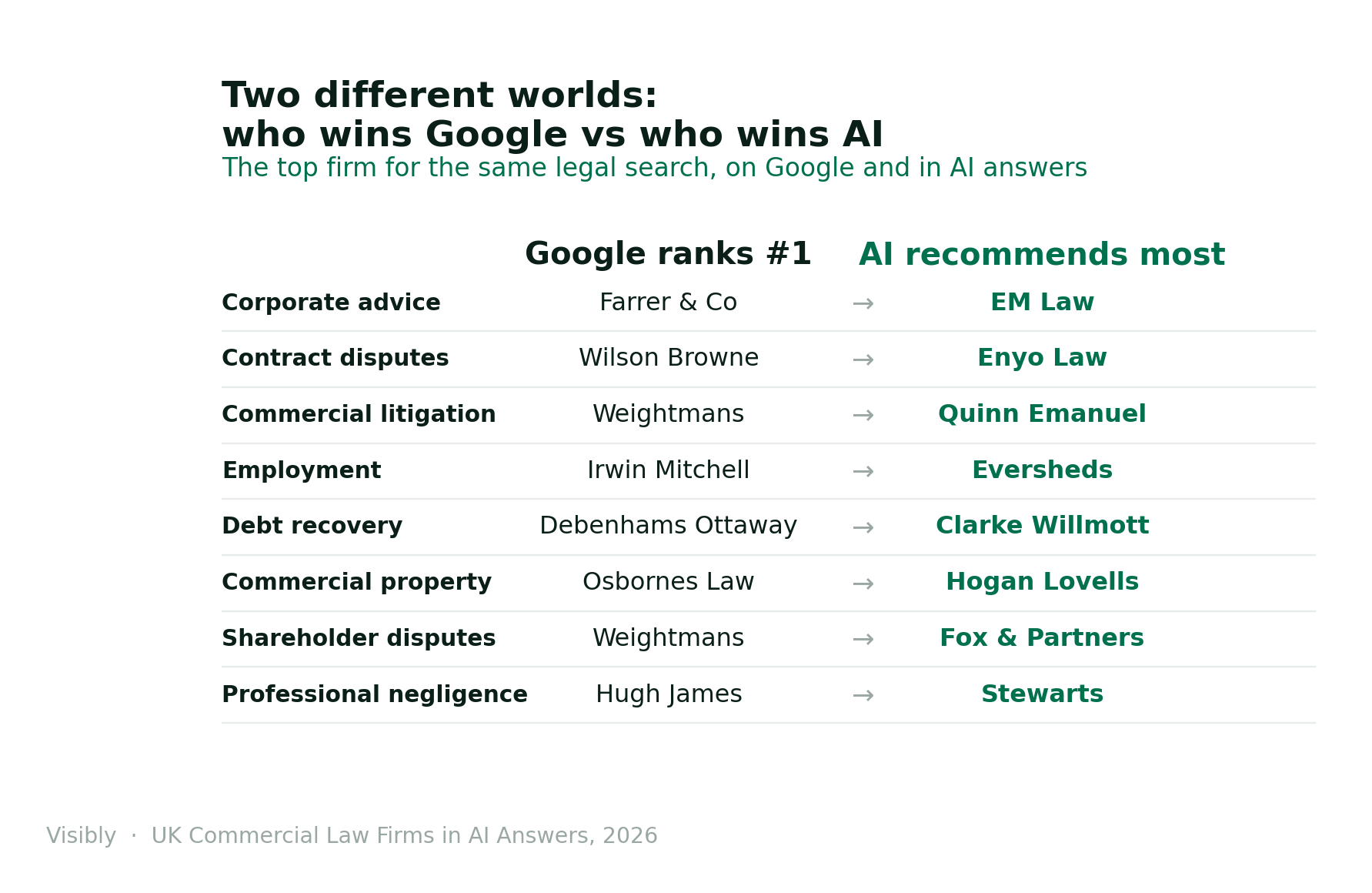
The firms winning Google are mostly mid-market and regional practices that have put real work into their service pages. The firms winning AI are the larger, better-known names. A firm can sit at the top of Google for "commercial debt recovery solicitors" and never be recommended by AI for it, and plenty of the firms AI recommends do not rank on Google's first page at all.
For any firm that wants to show up in ChatGPT, this is the single most important thing to take on board: the work that enables you to rank on Google is not the work that gets you mentioned by AI. Why the two diverge so sharply is the next finding.
Finding 2: AI reads two directories to recommend a law firm
Google and AI barely overlap because they read different things. Of the 2,604 sources AI cited across all 500 answers, three-quarters came from just two places: Chambers and Legal 500, with Chambers alone cited nearly three times as often as Legal 500.
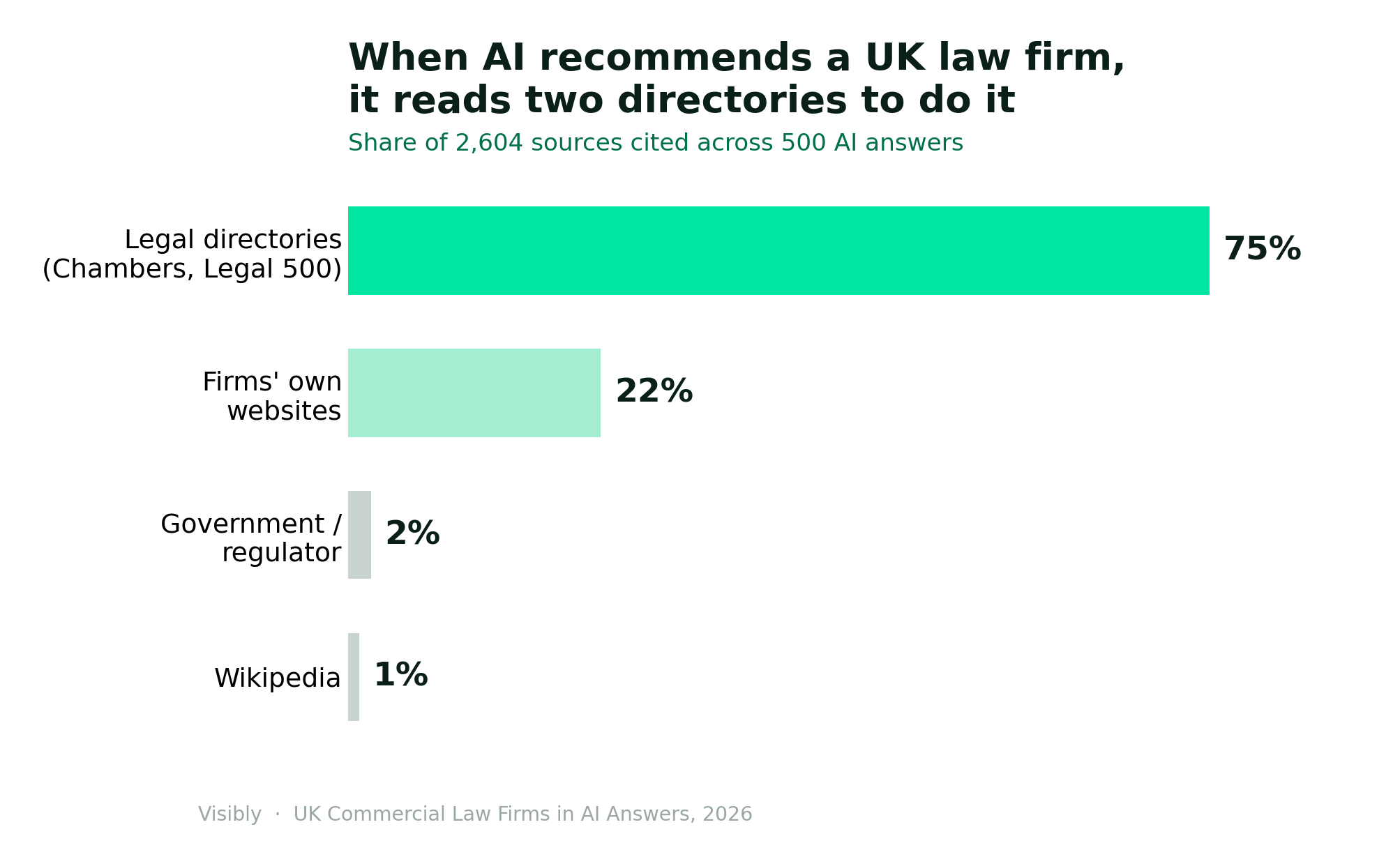
This is the explanation for the gap. Google ranks firms largely on the strength of their own websites, which rewards the ones that invest in SEO. AI mostly skips the firms' sites and reads the directories, which rank firms by reputation and editorial assessment. Two different sources, and so two different sets of firms. For a law firm, that is unusually clear direction: your visibility in AI answers is, to a first approximation, your visibility in Chambers and Legal 500.
Finding 3: AI recommends lawyers and accountants completely differently
Here is what makes the directory finding even stranger. We ran this same study on UK accountancy firms a few weeks ago, and you would expect the two to look alike. Both are regulated professions built on trust and credentials, both have professional bodies and formal rankings, both are considered purchases where you would expect AI to work the same way. However in practice, they behave very differently.
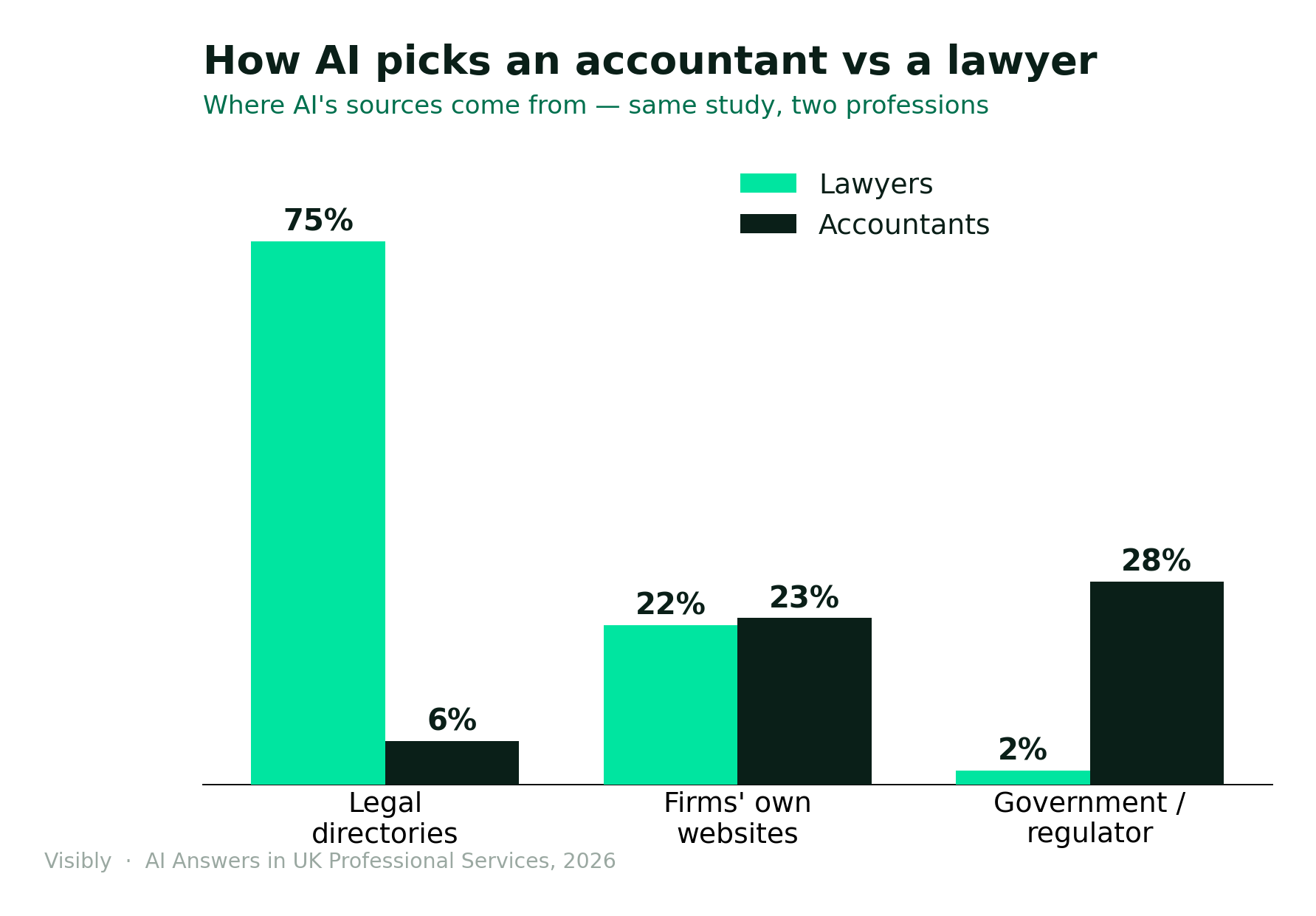
For accountants, AI spread its sources around: government and regulator pages (28%), the firms' own websites (23%), and directories at just 6%. For lawyers, directories jumped to 75% and everything else shrank. Same method, same AI, two regulated professions, two completely different maps of who influences the answer. You cannot assume your profession behaves like the one next door, and the only way to know how AI treats your sector is to test it and use a tool like Visibly to give you clarity, that you can then act on.
Finding 4: the law firms AI names most often
Across all 500 answers, these are the firms that came up most.
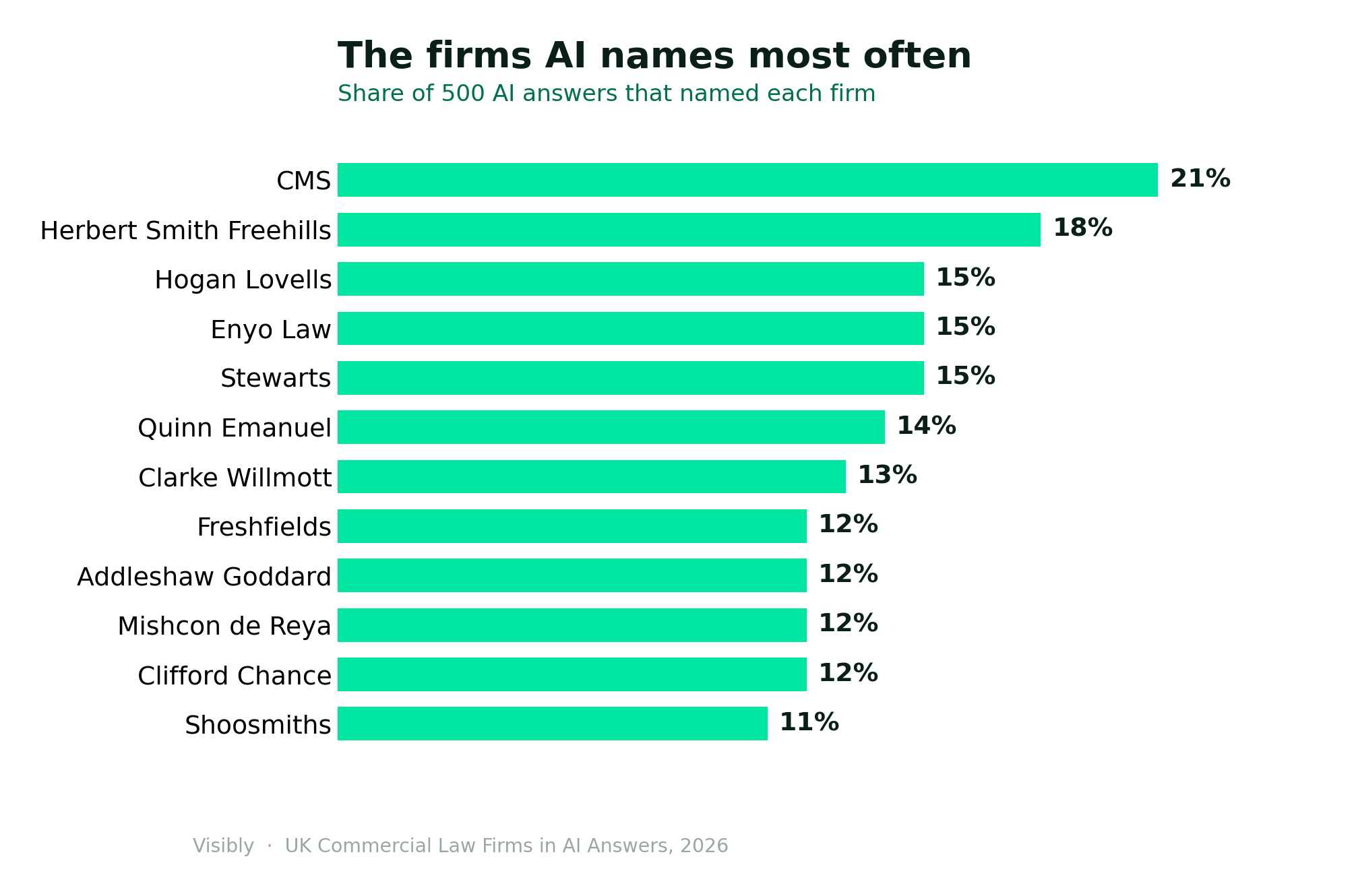
CMS led, named in about one answer in five, followed by Herbert Smith Freehills, Hogan Lovells, Enyo Law, Stewarts and Quinn Emanuel. Notice how few of them are the firms you would find topping Google.
Here is the encouraging part, though. More than 300 different firms were named at least once, but only sixteen showed up consistently, in at least one answer in ten. That gap is the opportunity. The prominent set is small, and it is decided by directory presence and content rather than firm size, so a firm that takes AI visibility seriously has a real chance of breaking into it. Most companies from our analysis have not yet done any real form of AI optimisation, so if you're a legal business reading this, you have a real opportunity.
Finding 5: different firms win different legal problems
Being visible "in law" is not really a thing. Firms win specific problems.
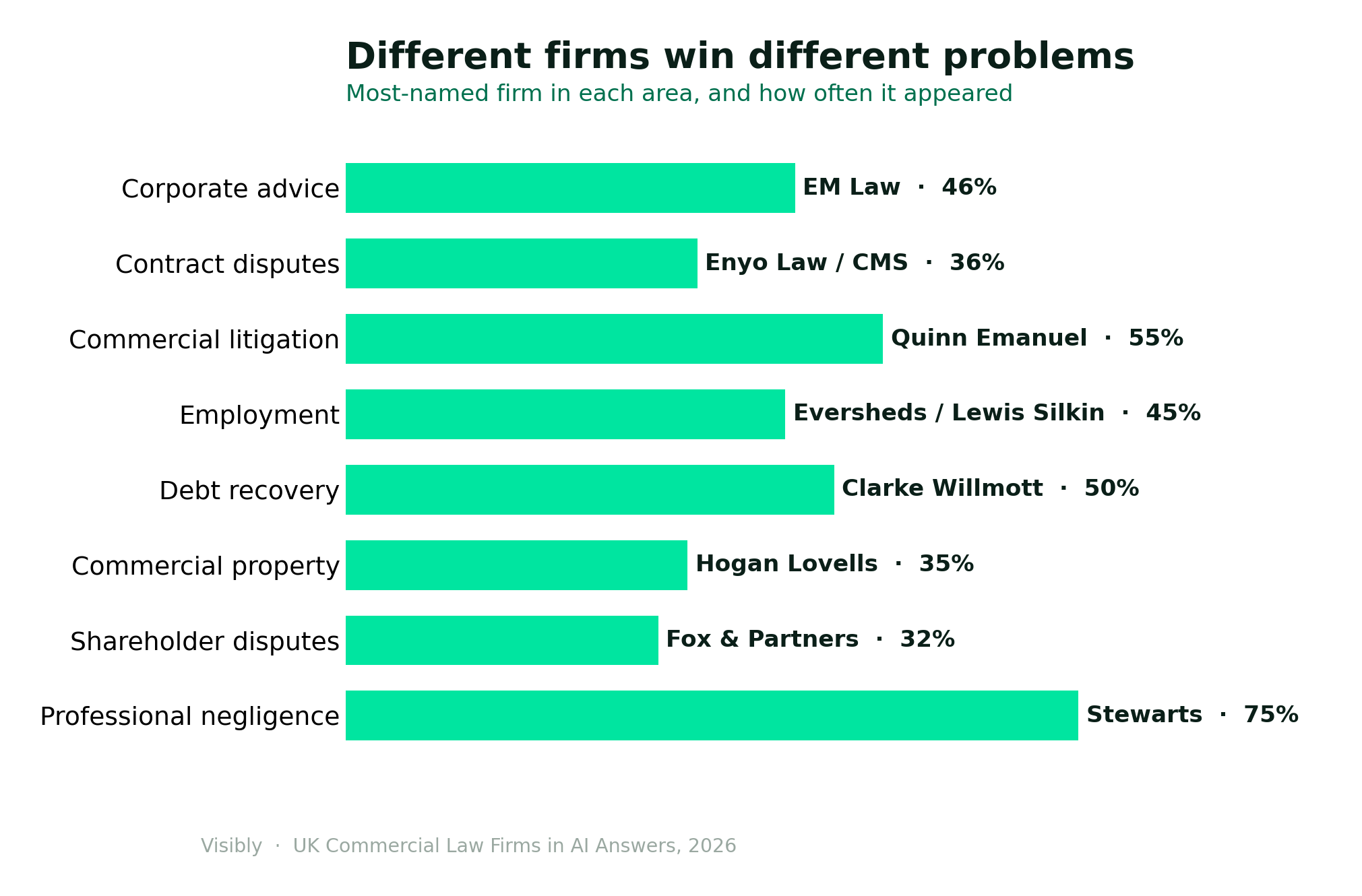
Quinn Emanuel and Freshfields dominate commercial litigation. Eversheds and Lewis Silkin own employment. Clarke Willmott is the name for debt recovery. Stewarts appeared in three-quarters of professional negligence answers. A firm can be the first name AI gives for one problem and never appear for the one beside it, which is where the opportunity sits: you do not need to be visible everywhere, just the obvious answer for the two or three problems you actually want the work for and are really close to your business proposition.
Finding 6: AI recommendations are live, not memorised
On a separate run we let AI decide for itself whether to search, rather than forcing it. For legal recommendations, it searched every single time.
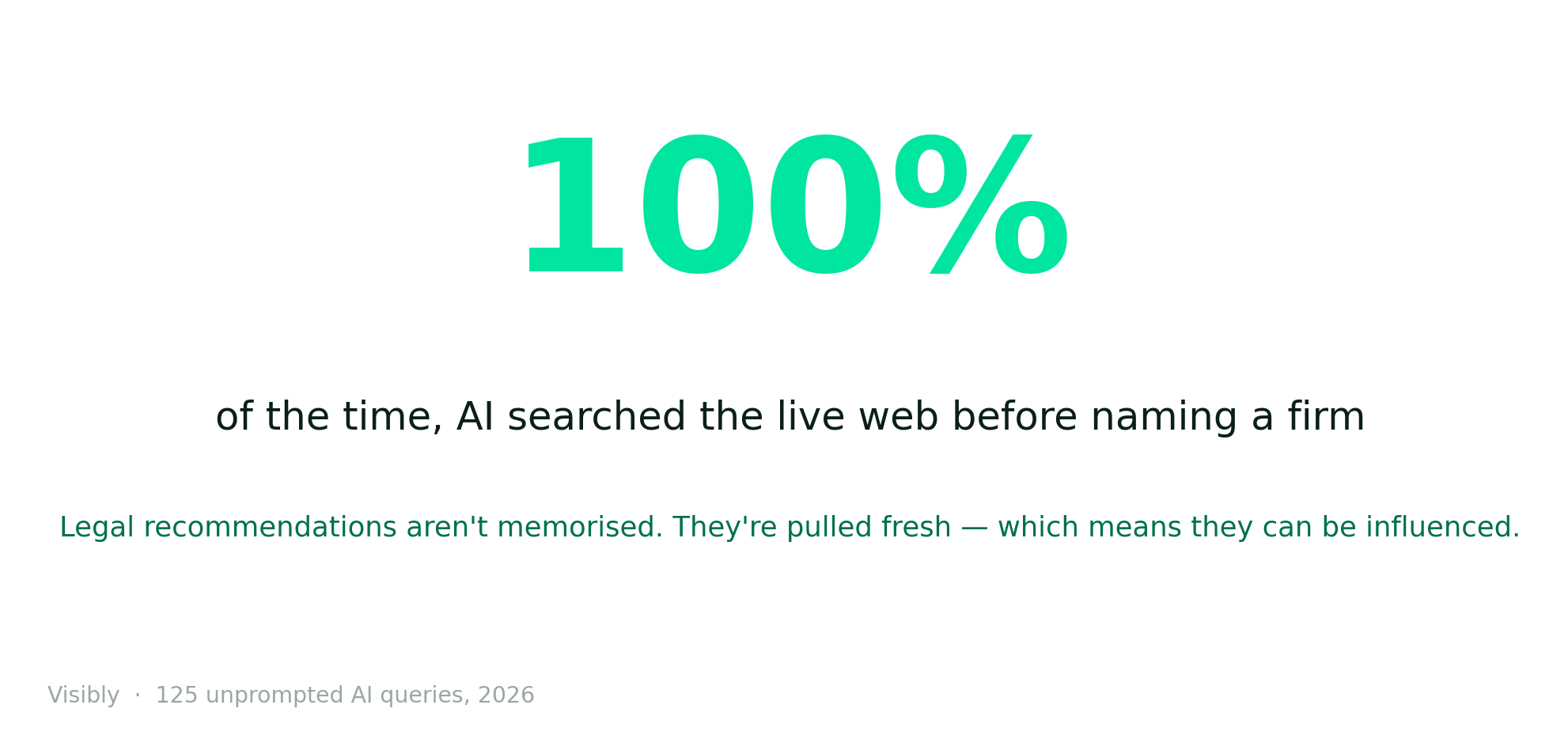
This matters more than it first appears. If AI answered from memory, its recommendations would be fixed and slow to shift. Because it searches every time, the answer reflects whatever is findable that day. Change what AI can find about your firm, and over time you change the answer it gives.
What this means for your law firm's AI visibility
Four things follow, roughly in order of priority.
First, treat AI visibility as a job separate from SEO, because your Google rankings mostly do not carry over. That cuts both ways: there is room to win the AI answer even where you cannot outrank the established firms on Google.
Second, get your directory rankings right, since Chambers and Legal 500 are three-quarters of what AI reads. Make sure you are ranked in the practice areas you want, and that your profiles are complete and current, because AI quotes them closely.
Third, build content AI can actually cite. A fifth of citations still went to firms' own sites, and AI searched live every time, so a clear page for each problem you want to win, answering what you do, who for, the process and a real example, can be pulled into the answer. Write it plainly and put the answer first.
Fourth, go after specific problems rather than "commercial law" in general, because AI recommends firms problem by problem. Pick the two or three you actually want the work for and go specific and deep into that problem to demonstrate your experience.
Those are the general key points, however there's lots more to getting mentioned and cited, too much to explain in one article. The specifics are firm by firm: which directory categories you are missing, which pages to build first, which problems you are closest to winning, and which competitors are taking the answers you want. That is the detail Visibly works out for a given firm. All of it is measurable, which is the part most firms have missed, and very few have looked.
Getting recommended by AI is learnable
Join the waitlist and I'll send what we're finding out about how AI engines choose which firms to name, and what you can do about it. You'll be first in when Visibly goes live.
No spam, unsubscribe anytime.
Frequently asked questions
Does ranking on Google mean AI will recommend my firm?
No. In this study only 6% of the firms ranking on Google's front page for a legal search were the firms AI recommended for the same search. AI visibility is a separate job from SEO, because AI reads different sources than Google ranks.
Which law firms does AI recommend in the UK?
Across 500 tests, the firms AI named most often for UK commercial-legal problems were CMS, Herbert Smith Freehills, Hogan Lovells, Enyo Law, Stewarts and Quinn Emanuel. More than 300 firms were named in total, but a stable group of around sixteen accounted for most of the recommendations.
How does AI decide which law firm to recommend?
Mostly by reading two legal directories. Chambers and Legal 500 made up 74% of every source AI cited when recommending a UK law firm. A firm's ranking and profile in those directories is the single biggest factor in whether AI names it.
How can a law firm improve its visibility in AI answers?
Do not assume Google rankings carry over. Get your Chambers and Legal 500 rankings and profiles right first, then build clear answer-first content on your own site for the specific problems you want to win, and make sure the site is readable by AI crawlers.
About the author. Jack is the founder of Visibly and has spent over a decade in SEO and digital strategy, including a senior digital director role at a FTSE 100 company and agency work for national brands. He built Visibly to measure and improve how AI answer engines recommend brands. More about Visibly.